
How To Write An Award-Winning Story - Gary Smith - The RV Book Fair 2025

To be an award-winning author, you must read a lot to find your voice. If you enjoy reading nonfiction history, don’t think you will write a great romance novel.
Write from experience. Hemingway said, “If you have not experienced it, you can’t write effectively about it.” So, put part of yourself and your experiences into your stories. Don’t be afraid to expose yourself; make it real.
Know why you write and stay focused on that. You cannot please everyone. Staying focused on why you write helps with the criticism, and it makes the praise that much sweeter.
Do not think too far ahead in a story you are writing. Instead, focus on the scene and the characters. If the characters are real and have a personality, they will come to life, take over, and direct the story.
Develop the discipline to write every day. I can always throw it away, but write something. It can be gobbledygook, but write. In my opinion, writing every day keeps the story flowing smoothly from one chapter to the next. I have been asked if I have experienced writer’s block. I haven’t. I believe it’s because I write every day, keeping me in the flow of the story.
It is also essential to overcome any fear of criticism. I believe many people are afraid of criticism because it is often perceived as a form of rejection. No one likes to be rejected. The downside of being afraid is that it limits risk and opportunity. Never be afraid to expose part of yourself in your characters. It is your chance to address some of your fears and phobias through your characters. It makes them real.

I draw confidence from reading about great authors and reading their writings. Ernest Hemingway, James Joyce, Raymond Chandler, Dashiell Hammett, Ezra Pound, and others. Dashiell Hammett wrote only five novels and suffered from writer’s block for over thirty years.
It was reading that William Faulkner wrote a sentence in the book Absalom, Absalom that was 1,288 words long. It gave me the confidence to not worry about my dyslexia.
Reading about their struggles and how they overcame them keeps me focused on my craft. Studying how they used the language and developed characters has been invaluable.
I have issues with many of the grammatical programs. I am dyslexic, and after proofreading the manuscript twice, I will have one of the programs check it for any mistakes I may have missed. It will always want to change the dialog; I will not change the dialog. My characters don’t speak that way.

I have been asked where the inspiration comes from to write an award-winning story. Is it living in Italy? Is it a beautiful sunset? For me, the inspiration never comes from outside stimuli, but from inside. It comes from the work, and for me, writing is work. When I start a new story, the focus is on the character and the scene that unfolds around them. What is going on with him or her? What are they thinking? Is the character excited about something or depressed about something? It doesn’t matter which you choose; it is a place to start. Where are they waking up in bed or sitting on a porch with a glass of wine?
As an example, I awoke and looked through the dark room at the luminated nightstand clock. It was 2:30 a.m. Then I heard it again; someone was downstairs.
Is this a man or a woman? Are they alone? Answering these questions raises additional questions, and soon Chapter One is finished. As I write, answering these questions, I am soon drawn into the story, wondering where my character is taking me.
The inspiration comes from the work. That is why it is essential to write every day.
Gary Smith from a young age, found joy in solitude and imagination. Fascinated by people and their interactions, he developed a keen observational eye. Encouraged by his intelligent brother, Gary immersed himself in literature, reading Cyrano de Bergerac in fifth grade, The Canterbury Tales in sixth, and novels like To Kill a Mockingbird and Breakfast at Tiffany’s before finishing high school.
At sixteen, he decided against college, seeking hands-on experience instead. After working as a general laborer, he trained as an electrician and eventually founded his own electrical contracting business in 1979, growing it into a national multimillion-dollar company.
The arts have always been central to Gary’s life. Gifted his first camera at eight, he held his first solo photography exhibition in 1981 and later received an invitation from Ansel Adams to attend his 1983 Carmel workshop alongside notable photographers.
Writing became a passion in the 1990s. Participating in California’s Connections Leadership Project, Gary contributed three pieces to Options: Making Connections in Today’s World (1997). One article, reflecting on the death of his son, profoundly impacted a reader at the project’s closing luncheon, underscoring for Gary the transformative power of words and the reason he writes.
Find out more at https://garysmithauthor.com.
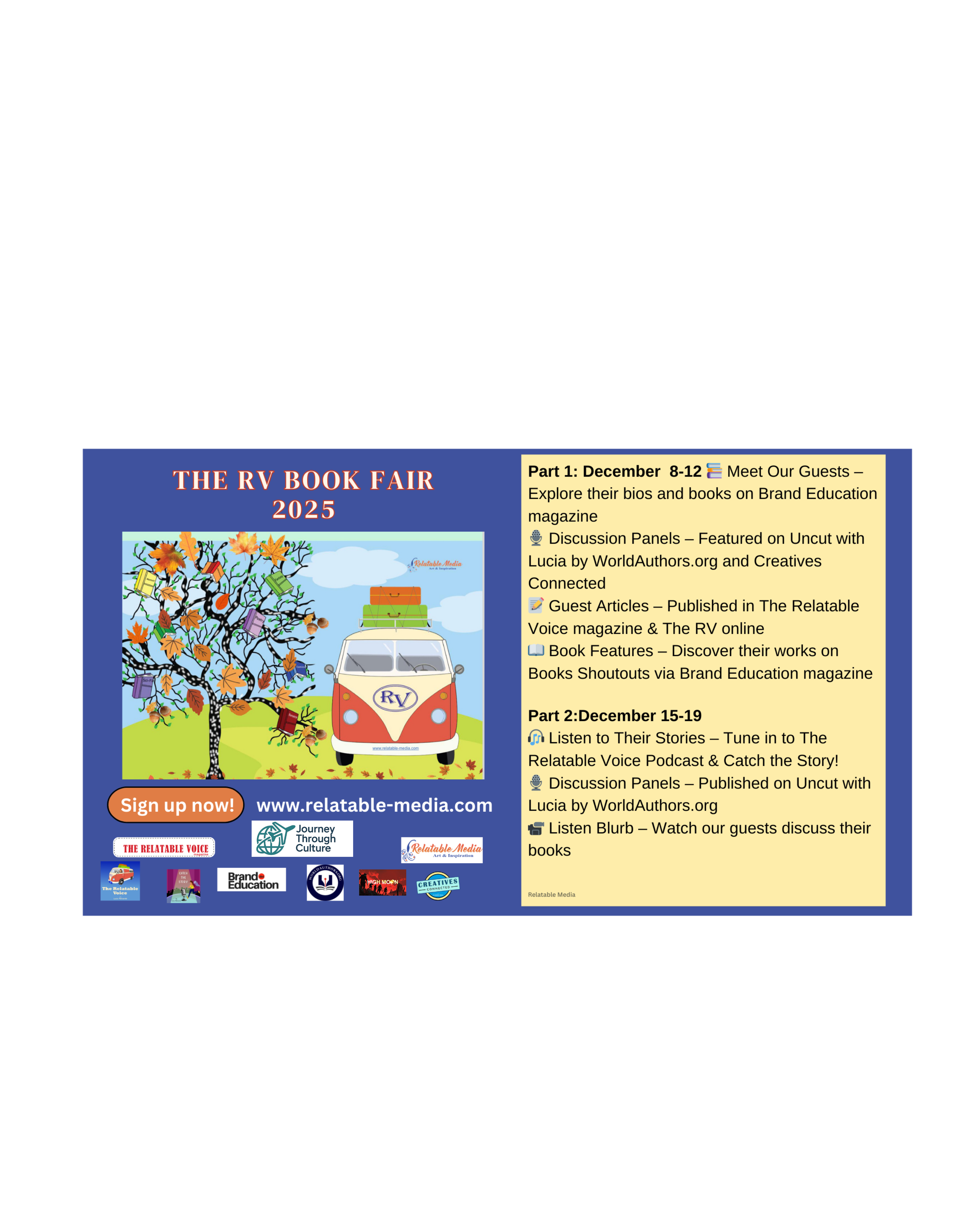
Article published in The Relatable Voice Magazine - December 2025 as part of The RV Book Fair 2025. Downolad the full magazine at https://www.relatable-media.com/the-relatable-voice-magazine


Comments