
Interview with Melissa Morelli Lacroix - The RV Book Fair 2025
Updated: Dec 14, 2025

Hi Melissa, as both a pianist and writer, how has music shaped the way you write?
Good question. My musical background makes me very aware of sound and flow, which leads me to write by editing as I go. Years of practicing and teaching piano trained me to focus on small details to shape a whole piece. While many say editing-as-you-go slows writing and disrupts inspiration, free-writing has always felt unnatural to me. During my Distance Learning MA at Lancaster University, my tutor Michelene Wandor—also a musician—assured me that if editing while writing produces work I’m happy with, then it’s perfectly fine.
Music also shapes my writing, especially poetry, influencing both narrative and form. My collection A Most Beautiful Deception (University of Alberta Press, 2014; soon to be republished) is the best example. I wrote three sets of poems corresponding to three collections of piano pieces; each poem shared the title and a formal relationship to its musical counterpart. Sometimes the number of lines matched the measures of music; sometimes a five-part song became a cinquain. Whenever the music repeated or quoted another piece, I mirrored it. My love of music history led me to weave in details about composers and the creation of the works. The poems became both academic and lyrical.
My recent prose also grew from music. Adventures of Ivan, my novella, contains eight stories named after and inspired by the pieces in Aram Khachaturian’s 1948 Ivan collection. I kept the mood, the name Ivan, and the Eastern-European connection—Khachaturian was Armenian Soviet; my Ivan’s ancestors were Polish-Ukrainian and Russian. Unlike the boy in the original, my Ivan is 97—though, as I’ve said in interviews, a 97-year-old man is still an old boy.
My forthcoming novel Song of Songs also began with music. For an early Lancaster assignment, all I had in my mind was a French folk song. I wrote out its verses and, between them, told the story of two imagined people who might have sung it. I repeated this process with more songs, and over the years those linked stories became the novel you’ll soon see.
Do any of your experiences teaching piano or writing appear in your characters or stories?
Funnily enough, no, not really. I think my upbringing, beliefs, and experiences appear in my characters and stories much more than my writing and teaching experiences. However, since I’ve been doing both for so long and I’ve arrived at a point in my life in which most aspects of my being have coalesced into one unified being, I’m sure something from the decades does appear. In fact, as I’m typing this, I am reminded of certain choices I made for the characters in Song of Songs that stem from piano teaching and writing related experiences: Stéphanie’s music education courses, the lesson books her cousin uses, some of the pieces Émilie plays, and hydrangea plants (I’d never seen these until I went to Lancaster University as part of my M.A. writing program).
What inspired you to tell the story across 4 generations, shifting between past and present.
The Tremblay story actually began with Rose and Pierre meeting; however, once I knew who those two characters were, I needed to know more about where they came from, so I worked backwards and wrote about their childhoods and their parents. Then I wrote forwards: who they became as a couple and how their earlier experiences affected their children. That got a little out of hand and grew into something much larger than I knew it would. In fact, I didn’t intend the stories to be a novel—I just kept writing about these people until I had a book’s worth of interconnected episodic stories built around songs and prayers and showed them to a few editors and mentors. The former told me, “Short stories don’t sell,” and the latter helped me try to find a more cohesive, novel-like structure and narrative for all the stories. What eventually emerged was the fact that I needed one more generation (Stéphanie and Christianne) to connect all the stories and show the cumulative effects of generational traumas and experiences. By adding Stéphanie, I also made the story more relevant and timelier—of course, by now 1990 is almost historical! Still, it places Stéphanie in my generation and leaves room to explore the current century with her infant sister, Renée, and future generations…
Probably because the stories came out episodically and theme-based rather than chronologically, I didn’t decide to shift the narrative of Song of Songs between the past and the present—it simply seemed the only way for me to connect everyone and everything together.
Music plays a key role in the book—why did you choose it as the link between timelines?
Since there was always an intrinsic link between music and the creation and development of the characters in the book, it was natural that Stéphanie should sing the stories. What was not as natural was coming back out of these stories (or songs). I added dates to help readers, but that is a bit boring. Plus, since Song of Songs wasn’t constructed in a traditional sense nor written in chapters, I felt there needed to be more to connect the pieces of the story together: in came the idea of the suite. Now, the 1990 sections work like individual pieces (or chapters) that are interspersed between songs (or chapters) about the past. It made sense to me, and I hope it helps readers follow the passage of time and the various storylines of the book. Finally, as Canadian media theorist, Marshall McLuhan, said, “the medium is the message,” so I really had no other choice but to link the timelines this way.
Why was it important for you to highlight French-speaking communities outside of Quebec in this story?
This was not my intention at the outset—I simply wanted to tell the story of the folks who sing the folk songs, but, if the medium is indeed the message, then choosing Saskatchewan for a story about Francophones, who are only 2% of the population, is certainly a message as well. So why did I choose it? Because Rose and Pierre were inspired by my Fransaskois grandparents and because my mother and her siblings, and many of their generation, lost the French language, and because I refound it and was raising my children in French in what Stéphanie calls “a huge sea of English.” In other words, I chose to highlight French-speaking communities outside of Quebec for the simple fact that they exist.
You work across music, translation and literature—how do you balance these, and what advice do you have for blending different art forms?
It is said that art breeds art, so whatever art inspires you, follow up on it and let it lead you. However, one thing I’ve learned since entering the authorpreneurial world, is that the final “product” can also be an important consideration. I suppose that is where balance comes in to play for me. Also, I seem to work towards my strength—I am a better writer than composer or pianist, so I find inspiration in music and form it into words. Sometimes, I feel like this is a type of translation, but that seems like a discussion to have on St. Jerome Day (International Translation Day). I will be flexing my translation skills in 2026 when I set about translating 2025’s publications into French.

Melissa Morelli Lacroix was born in Saskatoon, Saskatchewan, Canada, and raised between grain fields and potash mines in nearby Viscount. From these beginnings, Melissa went on to earn a combined honours degree in Creative Writing and French with a certificate in Translation Studies from the University of Alberta, and a Master of Arts degree from Lancaster University. Elle vit et écrit en anglais et en français.
Melissa's writing has been performed on Edmonton stages, read on CBC radio, set to music, and published in Canadian, American, and British publications.
Melissa has one husband, one piano, two kids, and two cats.
Find out more at @melissamorellilacroix.
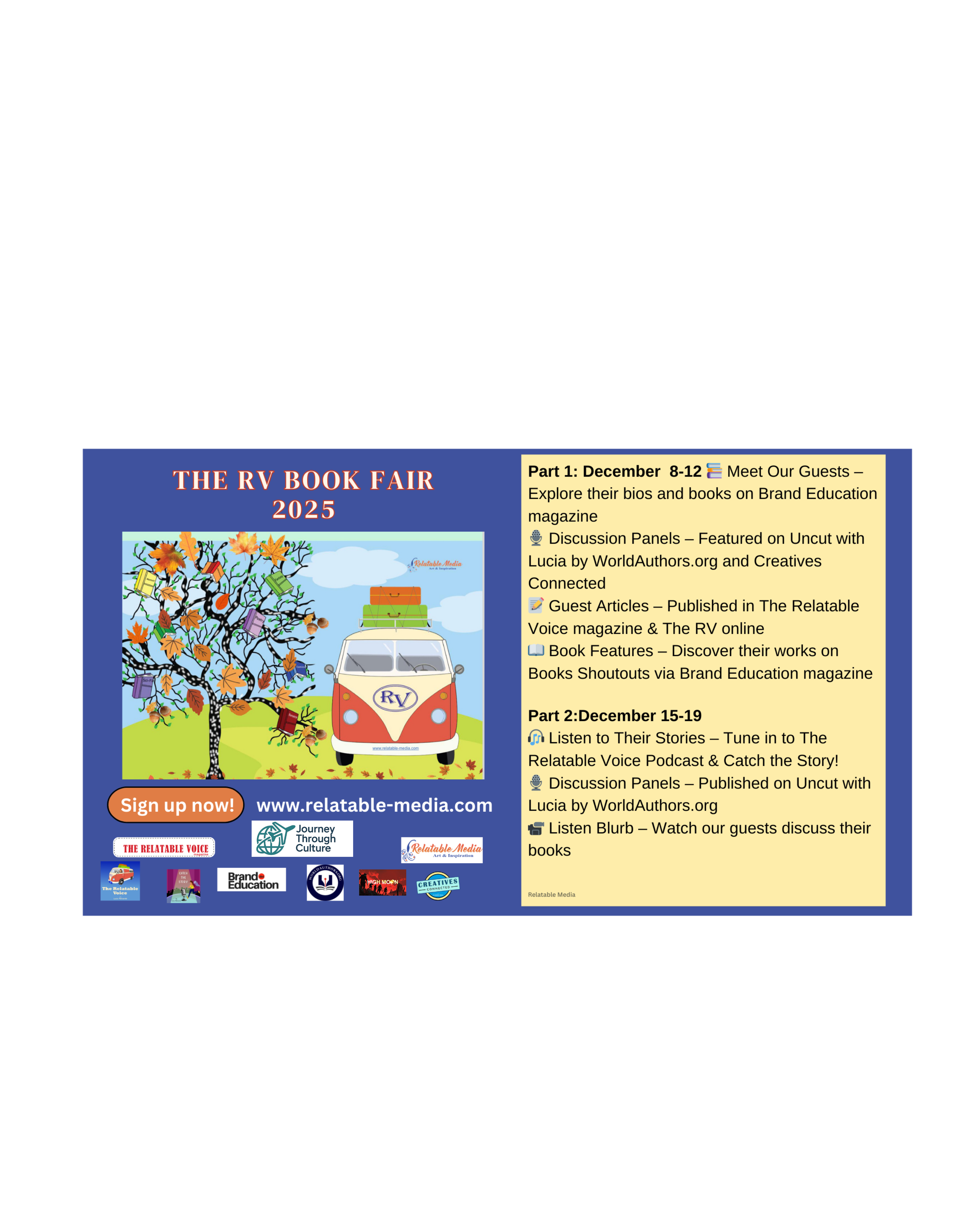
Interview published in The Relatable Voice Magazine - December 2025 as part of The RV Book Fair 2025. Downolad the full magazine at https://www.relatable-media.com/the-relatable-voice-magazine


Comments