
The RV Book Fair 2026: Interview with Kelly Caleb

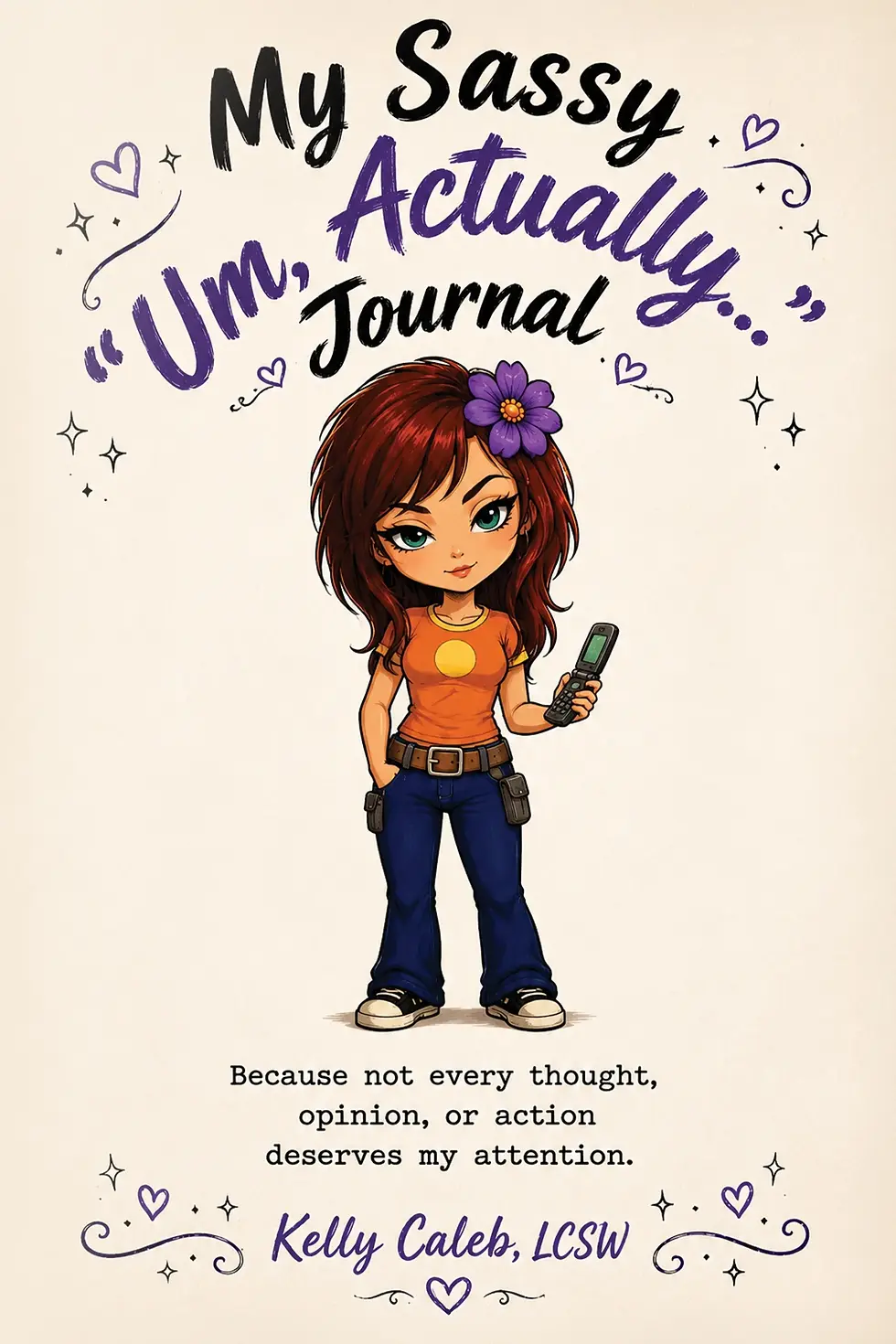
Kelly, welcome to The RV Book Fair! Tell us a little about yourself and how your journey as a writer began.
Thank you! I’m so happy to be back with The Relatable Voice. I’m an author and licensed clinical social worker, and much of my work has centered on helping people navigate anxiety, intrusive thoughts, difficult emotions, and the stories our minds can tell us about ourselves.
My writing journey actually began in a very different place—with children’s books. I created the Now Cow series to introduce emotional wellness concepts through playful characters, humor, and stories that children and families could enjoy together. Over time, I realized I wanted to create something for adults that carried that same combination of humor and emotional insight, but with considerably more sass. That eventually became My Sassy Um Actually Journal.
Your new book is Sassy. What inspired this story, and where did the original idea come from?
There’s a funny twist to this question: Sassy isn’t actually a traditional story. The full title is My Sassy Um Actually Journal, and it’s an interactive guided journal.
The idea came from noticing how easily we accept the first version of a story our mind gives us: “I ruined everything,” “They must think this about me,” “I can’t handle this,” or “This is going to be a disaster.” I wanted to create a journal that gave people permission to answer back—not with forced positivity, but with perspective, humor, and their own voice.
Sometimes the appropriate response to your brain really is, “Um, actually…”
Tell us about Sassy. Who is she, and what makes her such a special character to you?
I love this question because Sassy is really the reader.
She’s the part of you that can look at the dramatic story your mind has produced and say, “Wait a minute. Is that actually true? Is there another way to look at this? Do I even need to give this thought so much authority?”
Throughout the journal, that voice appears in different playful forms—the prosecutor, the security system, the doom forecaster, the roadblock, the sassy friend—and eventually the phoenix. But the reader is the one developing that voice. The journal isn’t telling you what to think. It’s helping you discover that you can decide how much attention and power you give to the thoughts that show up.
What are some of the main themes you wanted to explore through Sassy?
One of the biggest themes is that a thought is not automatically a fact.
The journal explores perspective, uncertainty, self-compassion, resilience, boundaries, emotional reasoning, catastrophizing, and our tendency to treat the mind’s predictions as though they are already reality.
Another important theme is humor. Personal growth doesn’t always have to sound solemn or clinical. Sometimes humor creates just enough distance from a difficult thought to help us see it differently.
And ultimately, there’s a movement toward resilience—recognizing what we have survived, what we have learned, and our ability to rise again.

How much of Sassy’s personality came from your imagination, and did any real people or experiences influence her character?
There is definitely a lot of me in the journal! I have a fairly sarcastic sense of humor, and I wanted the journal to sound more like the witty friend sitting beside you than an instruction manual telling you how you’re supposed to feel.
My professional experience as a therapist influenced the concepts behind the journal, but I deliberately wanted this to be something broader than a therapy workbook. It’s meant to be relatable to anyone who has ever had their brain confidently announce something that may deserve a second opinion.
So Sassy is partly me, partly the people I’ve known and learned from, and hopefully partly the reader discovering their own version of that voice.
Every memorable character faces challenges. Without giving too much away, what does Sassy have to overcome or discover during her journey?
Since the reader is really Sassy, the challenge is learning that you don't have to win every argument your mind starts.
That distinction is important to me. The goal isn’t to eliminate uncomfortable thoughts or manufacture a perfectly positive mindset. It’s recognizing, “My mind said this. What do I want to do with it?”
The discovery is that we have much more choice in our response than we sometimes realize. We can question a story, laugh at it, let it pass without solving it, set a boundary, redirect our attention, or decide that a thought simply doesn’t deserve the microphone.
What do you hope readers will feel or take away from Sassy after they finish the book?
I hope they feel lighter, stronger, and more confident in their own voice.
I’d love for someone to finish the journal and catch themselves later when their brain produces some enormous dramatic conclusion and instinctively think, “Um, actually…”
More than anything, I hope readers recognize that growth doesn’t require becoming a completely different person. Sometimes it’s about learning to trust yourself, make room for uncertainty, recognize the stories that aren’t serving you, and remember that you have choices about what happens next.
What’s next for Kelly Caleb? Can readers expect more from Sassy, or are there other stories and projects already taking shape?
There is definitely more taking shape!
I’m continuing to develop the world around my children’s books and the Now Cow characters, including an interactive game project that brings emotional wellness concepts into play in a completely different way.
And My Sassy Um Actually Journal has opened another creative direction for me. I love the idea of combining humor, emotional wellness, art, and interactive experiences in ways that don’t feel like traditional self-help. I’ll even give you a tiny spoiler: I’ve started working on My Sassy Bro Journal. I’m not quite ready to tell you what’s inside that one yet, but apparently Sassy is expanding her territory.
I have a lot of ideas—and apparently my imagination has no intention of respecting normal business hours.

Kelly Caleb helps adolescents and adults to overcome anxiety and trauma by using mindfulness, hypnotherapy, and Accelerated Resolution Therapy (ART). She is an accomplished writer of story books on overcoming mental health and behavioral challenges with mindfulness. When she’s not working or writing, she loves to hang out with her family, practice Spanish, learn Korean, and she stays active learning Jiu-Jitsu.
Find out more at https://kellycaleb.com.

Interview published in The Relatable Voice Magazine - The RV Book Fair 2026 - Special. Download the full magazine for free at The RV Book Fair | Relatable Media.



Comments